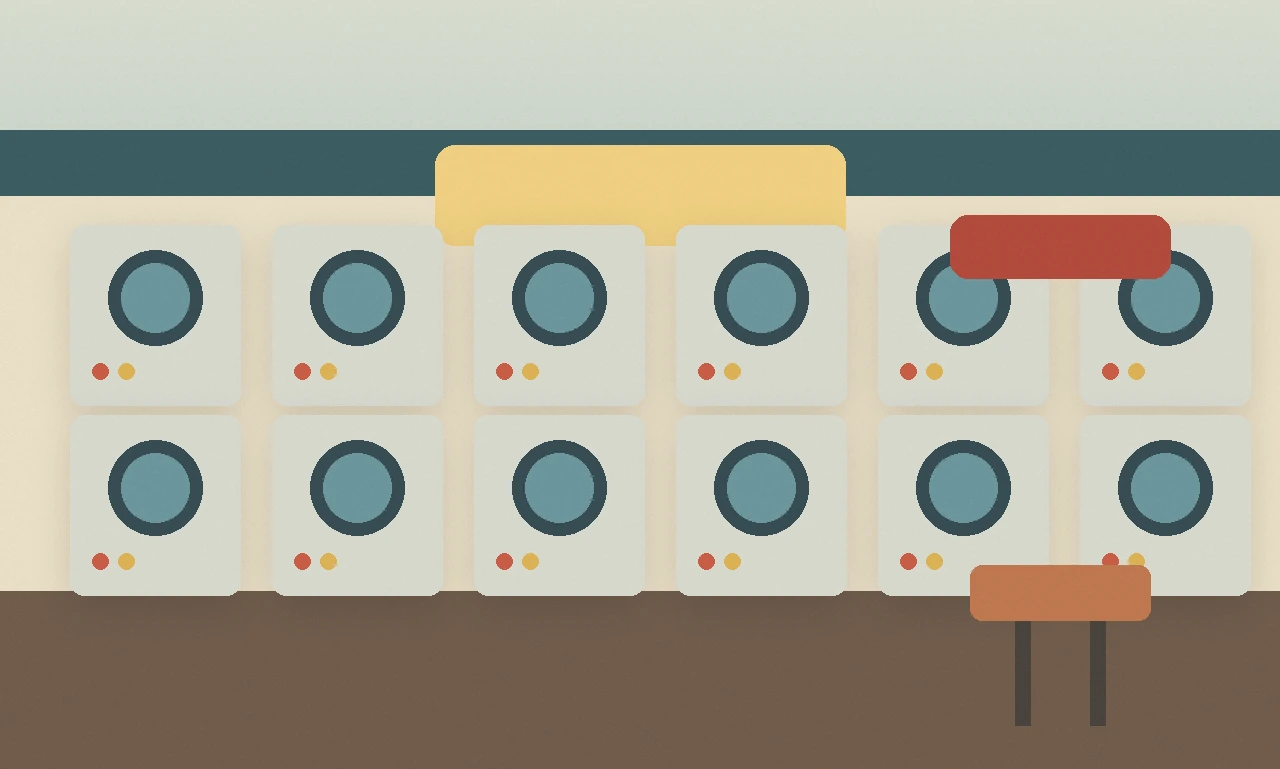
A room organised by time
A laundromat has its own clock. A load begins, the machine door locks and there is suddenly a period that cannot be hurried. People read, answer messages, sort clothes or simply watch the remaining minutes count down. The waiting is practical, but it also changes the pace of the room.
Unlike a café or shop, the central activity is mostly happening inside a row of machines. Customers may arrive with very different schedules and still move through the same sequence: choose, load, wait, transfer, fold. That repeated structure makes the space easy to recognise even when no two visits look exactly alike.
This does not mean every laundromat feels social or comfortable. Seating, cost, maintenance and opening hours vary. The useful observation is smaller: a necessary household task creates a shared interval in a public-facing place.
Small design choices shape the wait
A folding table, a working change machine and clear instructions can affect an entire visit. So can the position of the chairs, the width of the aisles and whether someone can see which machines are available without walking around every row.
Notice how the room explains itself. Are prices and cycle times easy to find? Is there a clear place for carts? Can a first-time visitor understand what to do without copying the person beside them? Good information reduces the need to guess in a room where people may already be carrying more than they can comfortably manage.
The same attention applies to courtesy. Removing a finished load promptly, leaving folding space clear and cleaning up a spill are small ways of recognising that the room belongs to the next person too.
See the ordinary infrastructure
Laundry is easy to treat as a private chore, yet not every home contains the equipment to do it. A neighbourhood laundromat makes that infrastructure visible. Water, power, machines, payment systems and a maintained room come together around a routine that is usually kept behind a household door.
The business may also serve as a landmark: beside the bus stop, below an apartment building or near the route people take after work. Its importance is not measured only by how photogenic it is. Reliability can matter more than novelty.
The next time a cycle leaves you with twenty minutes, look at the room as part of the neighbourhood rather than an interruption from it. The laundromat is a place of waiting, but the waiting is not empty. It is the quiet time required to keep ordinary life moving.
About this article
An original perspective from Everyday News. It offers practical ideas and perspective rather than firsthand reporting.

