Read the whole corner
A pedestrian crossing is easy to describe as a set of stripes on a road. In use, it is a small system of signals: lights, markings, curb ramps, traffic movement and the choices of people approaching from several directions. Each part asks for attention, and none tells the whole story alone.
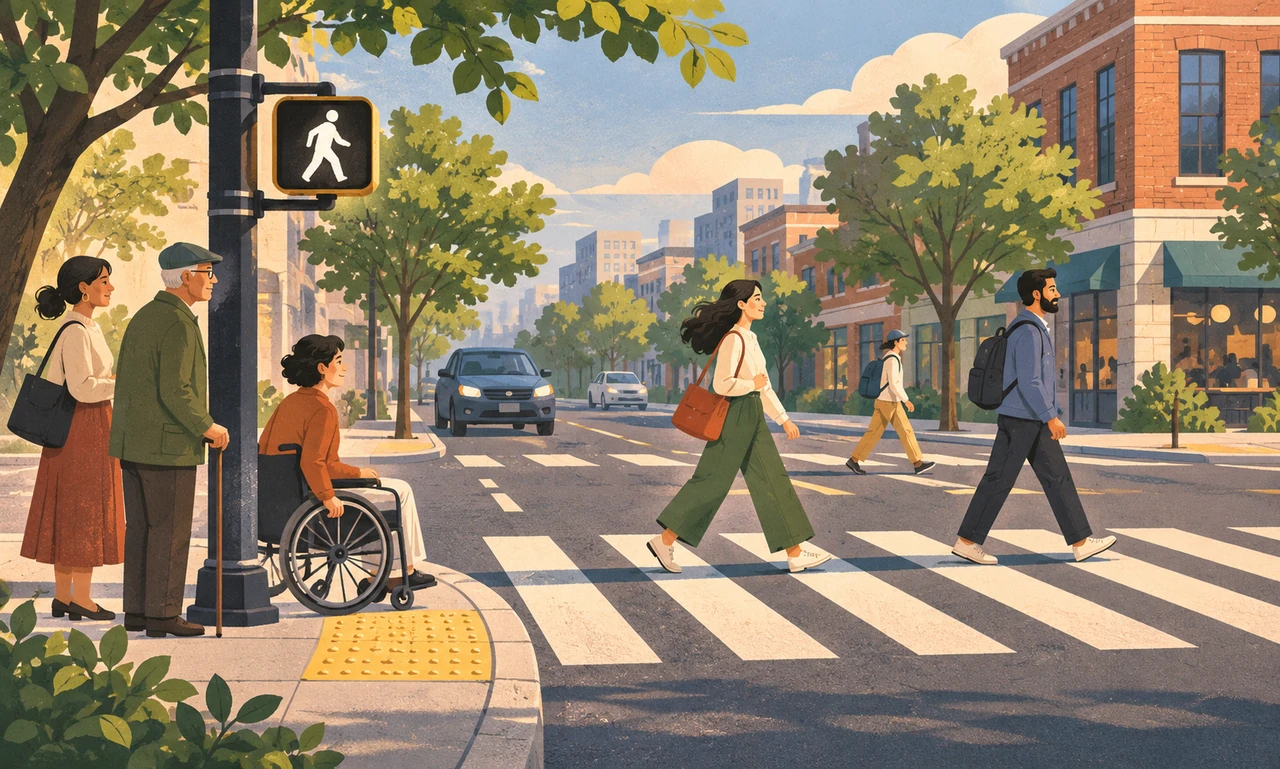
Begin by looking at a familiar crossing from a safe place. Notice where people wait, which signal applies to them and whether turning vehicles also move through the intersection. Look for tactile surfaces, islands or buttons without assuming that every feature works the same way in every city.
The exercise is observation, not an invitation to test uncertain conditions. Follow local traffic rules and current signals. If a crossing is damaged, obscured or malfunctioning, use the relevant public reporting channel rather than stepping into the road to investigate it.
Notice the sequence
The order matters. A signal changes, traffic pauses, people begin to cross and the corner briefly becomes a shared path. Someone moving quickly may experience that interval differently from someone using a mobility aid, guiding a child or carrying parcels. A countdown is information, but it does not erase those different circumstances.
Watch one complete cycle and write down only what you can verify. How long is the route? Is the waiting space clear? Do drivers turning into the crossing have a separate phase? A precise note is more useful than a general claim that the corner feels good or bad.
Avoid treating another person’s pace as a problem to be judged. The crossing exists for many kinds of bodies and journeys. Its ordinary civility depends on leaving room for people whose timing is not your own.
Carry the attention forward
Once you have noticed the system, the painted lines may stop looking like decoration. Maintenance, visibility and timing become part of how a neighbourhood connects. A destination across the street is only practically nearby if the route to it can be understood and used.
If you report a concern, include the exact intersection, direction of travel, time and visible condition. Separate a blocked curb ramp from a timing question, and avoid making a technical diagnosis without evidence. Good descriptions help the responsible team identify what to inspect.
The crossing offers a modest lesson in public life. Strangers coordinate through shared cues, brief patience and an expectation that the next person also has somewhere to go. The conversation contains few words, yet a whole corner depends on people reading it together.
About this article
An original perspective from Everyday News. It offers practical ideas and perspective rather than firsthand reporting.

